“The most important thing we've learned”
Charlie and the Chocolate Factory“The most important thing we've learned” is the Oompa-Loompas’ climactic song about television, performed after Mike Teavee is transported by Television Chocolate and reduced to a tiny figure. Its decisive significance is that it converts a bizarre technological accident into an explicit lesson: Mike’s obsessive screen-watching is presented not merely as bad behavior but as a threat to perception, imagination, intelligence, and the habits of reading that the song associates with an earlier generation.
Dramatic Setting and Performance
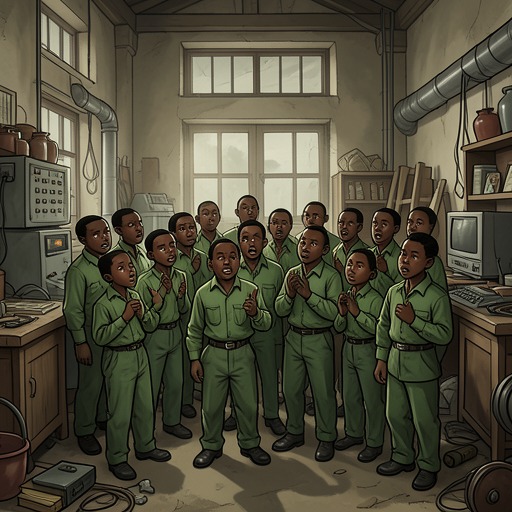
The song begins at the end of the Television-Chocolate Room, where the Oompa-Loompas around the giant camera beat their tiny drums and jog to the rhythm. Mr Wonka tells the gathered party that they cannot stop the singing. Little Charlie Bucket catches Grandpa Joe’s hand, and together they stand beside Mr Wonka in the middle of the long bright room to listen. The performance therefore follows Mike’s transformation immediately, while his parents remain confronted with the consequences of the experiment and the Oompa-Loompas take control of the scene’s interpretation.
The song is also part of a recurring structure within Wonka's Chocolate Factory. After the children’s dangerous encounters, the Oompa-Loompas appear with drums and collective singing: they chant after Augustus Gloop’s removal from the Chocolate River, begin another song after Violet Beauregarde is rolled away as an enormous blueberry, and announce Veruca Salt’s episode from down the corridor. In this pattern, song functions as both aftermath and verdict. The spectacle is not left as unexplained factory chaos; it is framed as a cautionary example whose meaning is delivered through rhythm, repetition, and public performance.
Television as Habit and Threat
The song’s argument is grounded in Mike’s introduction at home. When reporters arrive after he finds a Golden Ticket, Mike is annoyed by the visitors because they interrupt his television viewing. He sits before an enormous television set with his eyes glued to the screen, watching one group of gangsters shoot another with machine guns. His fascination is not occasional: he says that he watches television every day and watches all the programmes, even those without shooting. He praises gangsters, gunfire, stilettos, and knuckledusters, while eighteen toy pistols hang from belts around his body and he repeatedly leaps up to fire them.
This behavior gives the song’s denunciation a concrete object. Television is associated with fixed attention, violent imagery, imitation, and the collapse of ordinary conversation. Mike does not simply enjoy a programme; he treats interruption itself as an offense and imagines the televised gangster life as something he would like to enter. His body, surrounded by toy weapons and repeatedly springing into simulated gunfire, makes the screen’s influence visible before Television Chocolate turns that influence into a literal physical danger.
Mr Wonka’s invention intensifies the contradiction. In the Television-Chocolate Room, he presents Television Chocolate as his very latest and greatest invention and explains that it works by television, even while saying that he dislikes television except in small doses. He objects that children want to sit all day staring at the screen, and Mike immediately identifies himself with that description. The experiment thus places the medium’s promised power beside its alleged harm: television can transmit chocolate, and perhaps a child, across space, but the same technological fantasy exposes the danger of treating passive viewing as an unlimited way of life.
The Song’s Moral Progression
The central refrain begins, “The most important thing we've learned,” establishing the song as a general conclusion rather than a private reprimand aimed only at Mike. Its subject is children as a group, and its repeated emphasis on what has been learned gives the lyrics the tone of a collective rule extracted from the factory’s latest disaster. The warning is sharpened by the insistence that television must not be allowed to dominate a child’s life.
The song then describes television’s effects through a sequence of bodily and mental images. It declares, “IT ROTS THE SENSES IN THE HEAD!” and follows with “IT KILLS IMAGINATION DEAD!” and “IT CLOGS AND CLUTTERS UP THE MIND!” The escalation moves from the senses to imagination and then to thought itself. Television is represented as something that enters the head, damages its faculties, and leaves the mind obstructed. The language is deliberately physical: rotting, killing, clogging, and cluttering make an abstract concern about media consumption resemble a process of bodily decay.
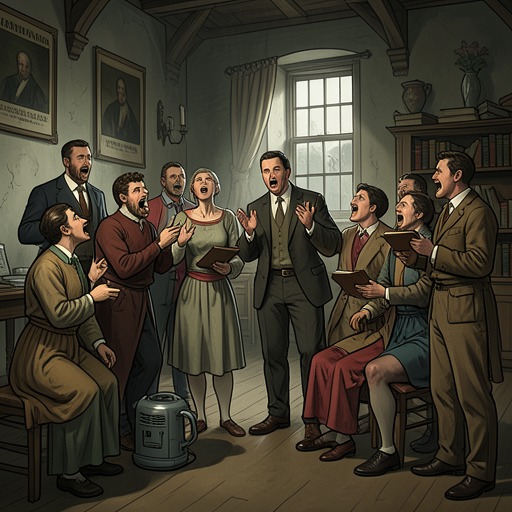
The Oompa-Loompas contrast this damaged mental condition with the reading habits they attribute to children living long ago. They ask whether the audience has forgotten and then proclaim that those children “USED TO … READ!” They repeat the word and extend it into an image of sustained practice: children read, read again, and proceed to read some more. Reading is consequently defined not as a single alternative entertainment but as an activity capable of continuation, attention, and accumulation. Against the immobilized gaze of Mike before the enormous screen, the song offers repeated reading as an active and intellectually enlarging habit.
Its final appeal turns the lesson into an imperative. The Oompa-Loompas plead, “So please, oh please, we beg, we pray,” and then urge the audience to “Go throw your TV set away.” The exaggerated sequence from request to begging to prayer gives the command a mock-ceremonial force, while the proposed replacement is practical: in the television’s place, the household should install books. The song therefore ends not merely by condemning a medium but by prescribing a reorganization of domestic space and daily attention.
Relation to Mike Teavee’s Fate
Mike’s reduction supplies the song with its most immediate evidence. He enters the Television-Chocolate Room as the child most openly committed to television, interrupts Mr Wonka, and recognizes himself in the description of children who stare at screens all day. After the experiment, Mr Wonka gives an Oompa-Loompa written instructions and says that Mike will be found in his father’s pocket. The parents are sent away with the reassurance that the damage will come out in the wash, but the drums and singing begin before the scene is over.
The song does not explain the technical procedure by which Mike is restored, nor does it make his fate psychologically complex. Its purpose is interpretive and disciplinary. Mike’s dangerous enthusiasm is translated into a maxim that can be repeated to the wider audience, while the transformation from boy to tiny figure makes the warning theatrically unforgettable. The physical change and the verbal lesson mirror one another: Mike is diminished by the device he glorifies, and the song diminishes television’s cultural authority by recasting it as a source of decay.
Narrative and Ethical Significance
“The most important thing we've learned” gives the factory’s episodic punishments a recognizable ethical grammar. Augustus Gloop’s appetite, Violet Beauregarde’s compulsive gum chewing, and Veruca Salt’s spoiled demands are each followed by Oompa-Loompa commentary; Mike’s television addiction receives the same treatment. The repeated songs encourage the audience to connect extravagant behavior with extravagant consequence, while the collective voices make private family failures into public lessons.
The song’s rhetoric is intentionally absolute. It does not distinguish between different programmes, viewing contexts, or amounts of television beyond Mr Wonka’s brief qualification that small doses may be acceptable. Instead, its strongest images and commands produce a memorable prohibition suited to children’s literature: television rots, kills, clogs, and must be replaced by books. That simplification is part of the song’s dramatic force. By joining grotesque bodily transformation to a chant about reading and imagination, the narrative makes media habits visible as choices with consequences, and turns Mike Teavee’s spectacular misfortune into the clearest warning in the factory’s catalogue of warnings.